Saturday, November 17, 2012

Battambang

Print Friendly and PDF
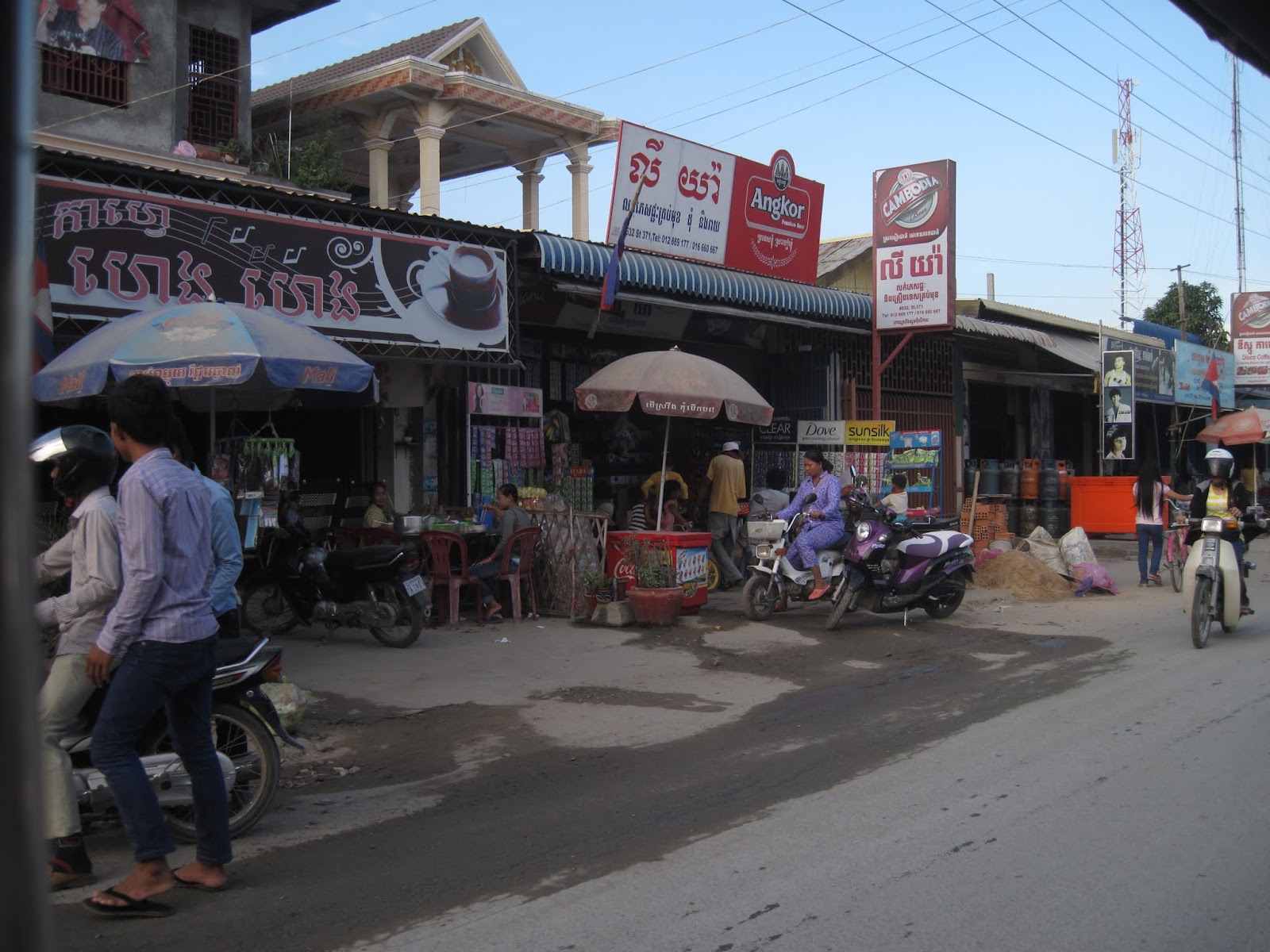
Main street of Battambang.  With a Camry LE of course.
Battambang is a fairly small town and gave us a chance to see some typical Cambodian life outside the capital and major tourist centers.  The town itself had an extremely relaxed feel to it -- great for wandering the street along the river and watching the locals come out for group aerobics as the sun went down.

Market stall selling all sorts of grilled things.

C enjoying grilled pork on a stick.   
We stopped at a market stall to get some yummy-smelling pork on a stick ($0.50).  Actually the meat was squeezed between two sticks.  Too bad we didn't think to remove the twine holding the sticks together and instead ate it more like corn on the cob.

A descending the steps while being fanned by helper children.
We visited two temples outside Battambang. The first was Wat Banan which is an old Hindu temple at the top of a small hill. We climbed 458 steps to the top accompanied by local children who fanned us each all the way up and back in hopes of a small tip. The temple was mostly in ruins but had also been appropriated by Buddhists and had Buddha statues under each surviving tower.

At the top of Wat Banan

Shrine inside Wat Banan


Fanning

Helper #2

Helper #3

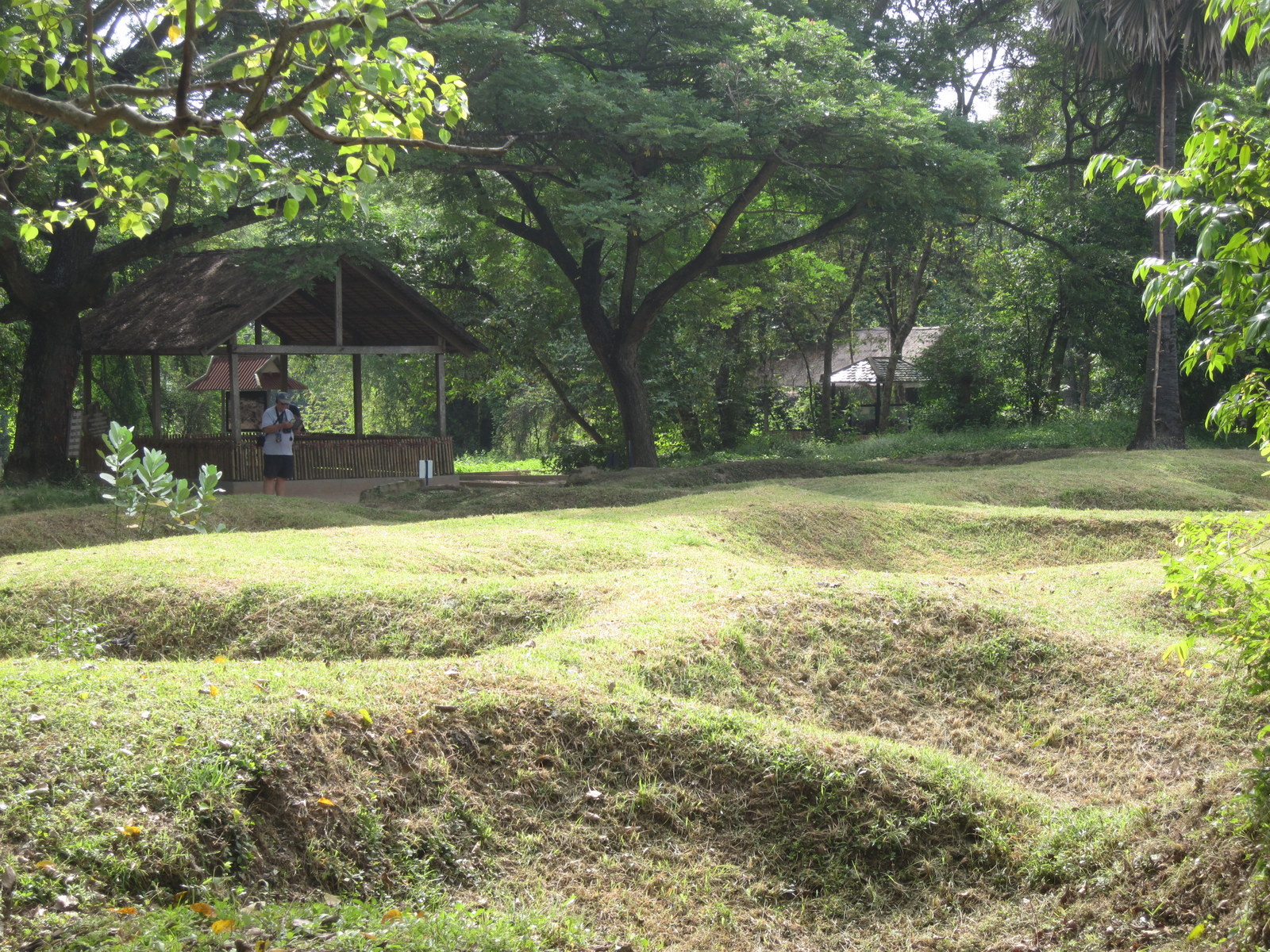
The second temple we went to, Phnom Sampeau, was more modern and had been built to honor the people who had been killed by the Khmer Rouge in this location and thrown into caves in the mountainside. The most memorable thing about this temple (for A, certainly) is that we paid $3 for a moto ride up to the top... A's fist time on any sort of motorbike/motorcycle.

A on a motirbike!  You saw it here first.


At Phnom Sampeau the helper-children spoke to our guide, rather than us.  They appeared to give our guide information about the site which our guide translated for us.  Accordingly, our guide gave the children some money this time.

At the top of Phnom Sampeau.  (Phnom means "mountain" in the Khmer language.

View from Phnom Sampeau

The hills sprout directly out of the plains.


After returning to the base of the mountain, our guide bought us some elephant apple fruit to try.  Not so tasty as it turns out, despite A's smile in the photo.

Next up was a ride on the Bamboo Train.  Railroad tracks were built by the French colonists in the 1930s.  The tracks haven't really been maintained since the colonists left Cambodia inthe 1950s.  Today the single-line tracks are used by a makeshift "train" car called a Nori made from two wheels, a military tank axle, a bamboo platform and a small gasoline engine (a la a lawnmower).  The axels and wheels are placed on the tracks and the bamboo platform rests on top of the axles (no fasteners at all).  The engine is connected to the axle by a rubber belt.  These contraptions barrel along at nearly 20 mph.  Some parts of the rail line are still used for transporting rice, people, and livestock on these same platforms.  This section is open for tourists.

On the Bamboo Train!
The fascinating aspect of the Bamboo Train is what happens when two "trains" in opposing directions meet.   Normally a rail line would have turnouts and signals.  Not here.  The platform with the lightest load (or the fewest people) must dismantle itself to allow the other platform to pass.

First remove the platform

Then take the axles off the tracks.
Set everything off to the side to allow the other "train" to pass.  Then reassemble.
Along the way we saw several Nori drivers beside the tracks in a group grilling meat and drinking beer.  In fact one driver hitched a ride on our nori from our starting point to join the party.

Excellent spot for some beers and grilled meat.

While leaving the Bamboo train, we encountered a tuk tuk full of extremely happy and friendly children.  They all waved and said "Hello" (the single English word known by 100.0% of the world's population).  C proposed a high five to them.  Initially confused, they figured it out before long.

Happy kids in a tuk tuk waving and blowing kisses.

Happy kids learning how to "high five." Moments like this are true  highlights of this trip.

The final site we visited in the Battambang are is an old house from the French colonial period.  The granddaughter of the original owner still lives there and offers tours to tourists.  She speaks French but not English. so she gave us a tour in French.  I think we understood approximately as much as we would have if she had spoken to our guide in Khmer and the guide translated for us.  The house was seized by the Khmer Rouge and used as a communal kitchen to feed 100 people at a time.  After the Khmer Rouge ended, the house was (miraculously, in our opinion) returned to its original owner.

Old French house.  100 people were fed underneath during the Khmer Rouge.

Demonstration of a machine to separate the chaff from the rice.


Wednesday, November 14, 2012

Over the potholes and through the floating village to Battambang we go

Print Friendly and PDF
(Oct 30th)

We were picked up at our hotel in Phnom Penh by Heng, our guide, and a driver in, what else, a Toyota Camry LE.

The drive to Battambang takes about 5 hrs from Phnom Penh even though it is 185 miles away because the roads leave a bit to be desired. The main road in Cambodia (their national highway equivalent) is one lane each way with frequent potholes and washouts that necessitate a lot of swerving and driving on the wrong side of the road. The road is also shared with lots of motorbikes, bicycles, trucks, and some horse drawn carts and the occasional herd of water buffalo or cows.

The number of shops along the way is amazing. Nearly the whole route is lined with small family shops selling everything from pillows to appliances to diesel pumps.

Along the way we stopped at a town that is known for silver work and saw a family making silver jewelry and other items. Even the toddler was practicing.

We made one more stop at a family that makes clay pottery grills. This was not a "tour" in any sense, we literally just dropped in on them at work and it was fascinating to see the different steps that go into making these clay grills. Throughout the rest of our time in Cambodia we enjoyed spotting these clay grills in use in floating and land-based homes, and food carts/stands.


We also visited Kompong Luong, a floating village with 10,000 inhabitants. After driving down a dirt road for a couple km we hopped in a local boat for a tour around the town. All of the children in the village would wave and yell "hello" as we passed. The village was a full town with a school, church, wedding hall, gas station, stores, and restaurants, all constructed on floating platforms supported by rafts of bamboo.
Washing dishes

bringing home supplies

Floating gas station

Kids in front of a shop

Busy "street" and Post Office/Police Station with flag at half staff

Typical transportation and dress

Kid rowing

Battery charging store

Kids waving

We saw one group replacing the old, soggy bamboo with new bamboo, which basically involved sliding the old "foundation" out from under the house and sliding the new "foundation" in.

The level of lake Tonle Sap varies drastically in the wet and dry seasons, so the village will have to move farther out into the lake as the water recedes. Rafts of bamboo had been left attached to anchors farther out to save the places for the dry season - very similar to "winter sticks" used on moorings in harbors in New England.
Cambodian "winter stick" for low-water mooring

Toilets in the village seem to be little huts suspended over the water from the side of the house with a hole in the floor. More pleasant to use than a land-based squat toilet but not so good when you see that everyone bathes and washes dishes in the water too.

We arrived in Battambang around 3:30 and were dropped at our hotel, Au Cabaret Vert. We usually spend a lot of time picking our hotel based on tripadvisor reviews and location. This is the first time we have booked a tour that included a hotel so we had no input at all in the hotel choice. We were a little skeptical when we pulled up to the hotel since it is a bit outside of town and there were construction tarps on the second story. It turned out to be a great little place with 6 bungalows, run by a French/Cambodian couple. We ended up eating dinner at the hotel one night and hanging out at the bar, and it really had a great atmosphere and everyone was treated like family. And it was an easy $2 tuk-tuk ride into the old town.

The bartender at our hotel was amazing - he was an incredibly friendly Cambodian guy from a nearby village named Sarin who did not have much education but had learned English and worked his way up from farmer, to Thai/Cambodian border guard, to tuk-tuk driver, to hotel security guard, to bartender.  He loves to practice his English so that he can speak English with his kids to make sure they learn English and can get good jobs.  He has also started a lending library for his local village school out of his front yard, and participates in "couch surfing" as a host.  If you ever need a place to stay in Battambang Cambodia, look this guy up!

Tuesday, November 13, 2012

Observations about Phnom Penh and Cambodia

Print Friendly and PDF
 (Oct 29th)
Sunset cruise on the Mekong River
Our first observation about Cambodia is that it is substantially less developed than anywhere else we've been. This is not surprising, given that it was only 35 years ago that the oppressive Khmer Rouge regime ended, and as recently as this year that the former leaders have been brought to justice.

Buildings along the road in Phnom Penh
Outside the downtown areas of the city, homes often have three walls and are built on stilts or have a dirt floor.  The walls are sometimes made out of woven bamboo or palm leaves or pieces of billboards or banners. They look like the smallest puff of wind would obliterate them.

Here is a summary of our observations about Phnom Penh so far.

Phnom Penh is known for its traffic. We had terrible traffic coming in from the airport, but it turns out Phnom Penh is actually a relaxed town to walk around (once you figure out that sidewalks are for parking motorbikes and that there are no apparent rules at intersections). There are limited taxis so the best way to get around is by tuk-tuk, which, unlike in Bangkok, do not try to take you to their friends' tailor/jewelry/souvenir shop. The riverfront area has lots of bars and restaurants. And unlike many places we've been, people actually GO to the bars and restaurants so it's more fun.

The beer is the cheapest we've found anywhere (50¢ to $2), and even upscale restaurants have most meals under $10.

The French influence from the colonial days is apparent. There are bakeries, we've seen baguettes about, and restaurants have affordable carafes of house wine.

The "Urban Resort" concept is really neat. Our hotel (The Plantation) described itself as an "Urban Resort and Spa." We figured that just meant that it had a pool and offered massages. Really it was more than that - after entering the complex off the street, the resort was built around two central courtyards each with a pool. There was a poolside bar, poolside cabanas, and best of all we couldn't even hear or see the busy street outside. All this for $60/night.


What the Khmer Rouge did to it's own people in the 1970s is really awful. They killed around 1 in 4 Cambodians and chose to execute people who were educated, smart, professional, doctors, even anyone who wore glasses. Now really, as if killing 25% of your population/workforce isn't crippling enough for your society, they killed the TOP 25% of their society. We visited the S21 genocide museum, which was a former school the Khmer Rouge turned into a prison, and reminded us very much of our visit to a Nazi concentration camp. We also visited the killing fields where in the 1970s millions of Cambodians we're bludgeoned and thrown into mass graves.  When it rains, pieces of clothing from the victims and pieces of bones and teeth still work their way out of the soil, and can be seen on the paths.  The Khmer Rouge tended to kill entire families, including children and babies, so there would be no one left to exact revenge later.  Many Cambodians have some family members who never returned after that time and no one knows exactly what happened to them.

Room at the S21 Genocide Museum
At the Killing Fields
Mass graves at the Killing Fields

Skulls excavated from the mass grave
Cambodia runs on US dollars. Prices pretty much everywhere are quoted in USD, ATMs dispense USD, and you even get USD as change. The local currency is only used as "cents" for purchases or change under $1 (example: to pay for something that costs $1.75 you pay with 1 US dollar, and 3,000 Cambodian riel). Credit card charges go through in USD. While using the dollar is convenient, it sometimes puts a floor on prices for things. Small items on the street or a short tuk tuk ride are $1, whereas in some other Asian countries they might be less than $1. No big complaint, really.

Every car is a Camry. Well, only 90% maybe, and most of the rest are still Toyotas. The wealthy seem to like Lexus, Range Rover, and Land Rovers.  It was a bit weird to see so many large vehicles after seeing small cars on most of out trip.  Our cab driver (while stuck in stopped traffic) told us that most cars in Cambodia are imported used cars from the US. They all seemed to have automatic transmissions and most speedometers read in MPH. We rode in Camrys with 144,000 and 220,000 miles. All have been reupholstered and look great from the outside.

After 5 days in Phnom Penh we will venture out of the city (with a guide and driver) to Battambang and then Siem Reap.

And now, here are some pictures from our time in Phnom Penh.

C getting a hair cut in Phnom Penh.  US$3.
40 minute Tuk Tuk ride to the killing fields.  Very dusty so our driver bought us masks.

Lots of things towed by a motorbike

Family of four on a motorbike (see the baby?)

The Grand Palace lit up at night to mourn the death of Cambodia's former king.

Sunday, November 4, 2012

Stumbling Upon an Electronics Market in Bangkok

Print Friendly and PDF
(Oct 25th)

We did manage to get out more on our second day in Bangkok.  We decided to go to the Museum of Siam, and we took a taxi. The streets of Bangkok are a giant maze and many streets are one-way. When we were about 2 blocks away from the museum, the street map looked one-way the wrong way so we paid the cab and hopped out to walk (I think the taxi was a bit confused). We saw in front of us a couple of stalls selling electronics and stopped to take a look.

C heading into the market


It turned out that there were not just a few stalls - there was an entire market (or district) spanning multiple blocks.
The market was amazing.  There were stalls selling every possible piece you might ever need for an electronics project.  Based on the stories we have heard A's dad tell about the Radio Shacks of yore that were for real hobbyists, before they became like mini Best Buys, A's dad would have loved this!

One shop sold connectors, another switches, another batteries, wire insulation, even one selling high-end test equipment like oscilloscopes.

Stall selling all kinds of doo-dads

We found a few items that would be useful to us, at very reasonable prices, so we ended up buying the following:
     Outlet splitter/European to American adapter -- $0.49
     Half of the power cord for our netbook -- $1.30
     (we had been having some trouble with the half that goes from the wall to the power brick)
     5-pack of CR2032 Lithium batteries -- $1.63

Even if these items turn out to be less than stellar quality, I think the price was right and it was fun doing some actual shopping at the market.

C buying an outlet splitter/adapter

We even managed to find a local restaurant stall in the market where we bought lunch for about $3 for two dishes and a yummy Thai iced coffee.  We don't really know what either of the dishes was (there was a lot of pointing and smiling involved) but one of them tasted an awful lot like Pad See Ew and they were both yummy.
C eating lunch at the restaurant in the market

In addition to any little piece you might need for an electronics project, there were stalls selling speakers, TVs (with tubes - no flat screens!), surveillance cameras, electronic test equipment (like C uses at work), DVD players, and every remote from every TV or VCR ever made.  It was truly impressive. Several stores were dedicated to car stereos and everything you need to trick out your car (or taxi, as we saw). Some shops had technicians at workbenches out front building and soldering things right on the sidewalk.
Stall selling every kind of remote (not universal remotes - the ones that go with each model)
Test equipment

After we had our fill of the market we walked to the Siam Museum and then managed to catch drinks watching the royal barge rehearsal in preparation for the King's 84th birthday celebration in November and then had dinner overlooking Wat Arun.


Saturday, November 3, 2012

Hello sir, buy something?

Print Friendly and PDF
Many of the places we have visited on this trip and others have markets, stalls, or small shops where locals sell things and often try to recruit tourists to come to their shop.  It has been interesting to see the different tactics used in different places.

Cusco, Peru - People did not really yell out to us as we shopped in Cusco's market, and I think generally did not speak English.

Bali - Stall proprietors say "You come look in my shop?" and "Just looking, please?" to tourists to get them to take a look at their shop. (They say "just looking" as a suggestion because tourists say "I'm just looking," and the proprietors just repeat it without really knowing the meaning.)

Shanghai - "Watch, bag, shoes, DVD" repeatedly called out as we walked down the street. (previous trip)

Phnom Penh - Children and women come up to restaurant tables on the sidewalk with a basket of guide books or bracelets or scarves.. "You buy book?".  When we say "No, thank you" they typically have a smart answer like "Why no?" or "But this one tells the story."  One particularly creative little girl selling bracelets (wearing an Angry Birds T-shirt) offered to C "Play Rock, Paper, Scissors... If you win, get 1 free.  If I win you buy 2 for $3."

Siem Reap - Most aggressive selling we have encountered yet.  At the temples, swarmed by young children who follow you repeating "3 for $1" (holding 3 bracelets) or whatever their offer is.  In markets, stall owners just say "Buy something" quite directly, or sometimes "Buy T-shirt?" or "Buy scarf?"